A list, a fence, and a clock
A Slam names the species, draws a boundary on real water, and gives you a window to do it in. Catch the list inside the fence before the clock runs out and you have completed it. Everything else here is a variation on those three things.
 Android coming soon
Four shapes, and they play completely differently
The format decides what winning even means, so it is the first choice when you build one.
Single species
One fish, and whoever catches the most of it wins. The Jupiter Inlet Snook Slam does not care what else you land. It is the format for water with one obvious prize, and it is the most common one in the app.
Multi species
A list of up to ten species, one of each. This is the classic grand slam, and it is scored on completion rather than volume, so the angler who finds the awkward third fish beats the one who caught forty of the easy one.
Hunt
One species, but you need several of them. Three largemouth, not one. Scored on speed, so it rewards a good session rather than a lucky cast.
Bag
A list where each species has a count. Two of these and two of those, like a bag limit. Fastest to fill it takes the period, which is the closest thing in the app to a tournament.
Three ways to be ahead
Completion
Did you finish the list. Order and speed do not matter, only whether every species on the card is in your log inside the fence.
Most catches
Volume wins. Used by single species Slams, where the whole point is who is really on that fish.
Completion speed
Finish it fastest. Used by Hunt and Bag, and it is the one that turns a Slam into a race.
One water, or a whole state
The fence is the point of a Slam. These are the two ways it gets drawn.
Water body Slams
The common shape. A species list tied to one named water, with a fence around it. Catch the list inside the fence and it counts. This is the format for a home lake, a stretch of river, an inlet, a pier.
Statewide Slams
Same idea, whole state. The Florida Largemouth Bass Slam does not care which lake you are standing on as long as you are in Florida. Built for species that move, and for anglers who do.
A circle, or the shape of the water itself
Radius
A circle around a point, which is what you want for a pier, a jetty, a bridge or a single hole.
Water body outline
The actual mapped shape of the lake or river, so a winding reservoir is fenced by its own banks rather than by a circle that spills onto land.
Either way the check happens against where the catch was actually taken, not where it was posted from.
Five durations, because a weekend and a season are different games
Weekend
Opens Friday, closes Sunday. A sprint, and the format most likely to get somebody out of the house.
Weekly
Resets every week, so a bad week is never the end of it and there is a new champion on the board seven days later.
Monthly
Long enough to need a plan and to survive a blown out weekend.
Evergreen
No end date. It sits open on the water permanently, which makes it the one people chip away at for a season.
Custom
Your own open and close dates, for a tournament weekend, a trip, or a run at a species while it is in.
Every Slam runs its own board
Joining a Slam puts you on its leaderboard against everyone else in it. You can see who is ahead, how far, and which species they have that you are still missing. It is the most useful board in the app because the field is small enough to actually catch.
- Ranked inside the Slam, separate from Strike Points and separate from crowns
- The species you still need called out, not just a number
- A champion per period, so the board clears and somebody new can take it
- An angler list so you can see who else is running it
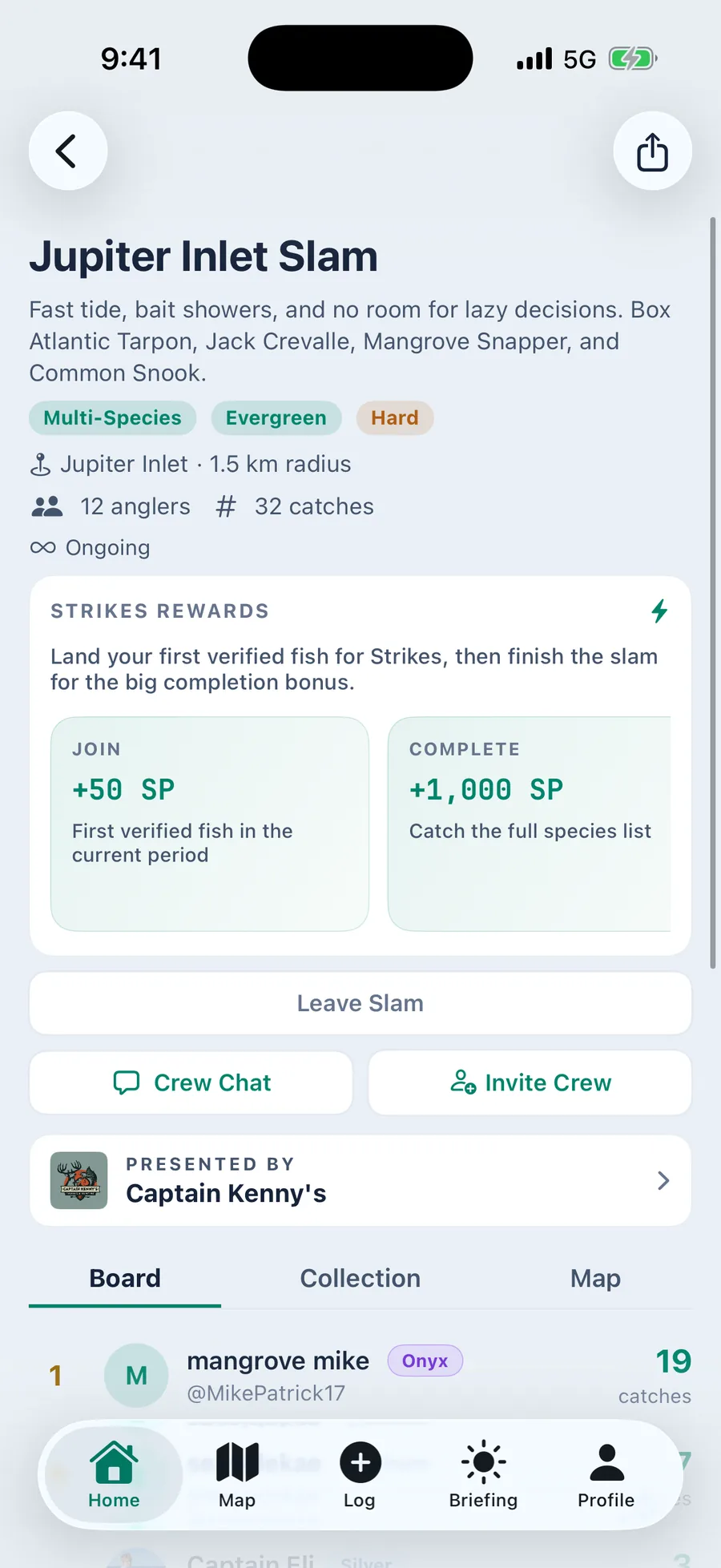
A Slam is something you do with people
The parts that make it social rather than a solo checklist.
Crew chat
Every Slam has a group thread for the anglers in it. Trash talk, conditions, who is heading out Saturday. It is the reason a Slam with four people in it beats one with forty.
Invite crew
Share a link and whoever you send it to lands straight in. No account hunting, no adding people one at a time.
Public or private
A Slam can sit on the map for anyone to find, or stay private and invite only. A private one is how you run a Slam for a group of friends without the whole app joining.
Strike Points for entering
Your first verified fish in a Slam period earns Strikes, so joining one is worth something even on a day you do not finish it.
Standard, hard, legendary
Rated by what the species list actually asks of you, not by how it sounds.
Standard
Species that are genuinely available to somebody who fishes that water regularly. Completable in a season without a boat, usually.
Hard
A list with at least one species that needs the right tide, the right month, or a run you have to plan for.
Legendary
Somebody will complete it and it will be a story. These are the ones with a fish on the list that most anglers on that water have never landed.
Difficulty is rated from the species list itself, so it is a description rather than a claim the creator gets to make.
The best Slams come from people who know the water
Slam creation is open to everyone, and every Slam in Cobia was built by an angler rather than shipped by us. That is deliberate. Nobody at a desk knows that your creek fishes three species well and a fourth only in November.
Pick the water, pick the species list, choose a radius or the water body outline, set the duration, publish. Then send the invite link to the people you actually fish with and run it as a group.
How Slams actually work
A named list of species, a fence drawn on real water, and a period it is open for. Log a verified catch of every species on the list, inside the fence, before the period closes, and you have completed it. It comes from the old inshore grand slam idea, made specific and checkable.
Yes, and that is where they all come from. Pick the water, pick the species, choose radius or the water body outline for the fence, set the duration, and publish. The app validates the location and previews the card before it goes live.
Yes. Every Slam ranks the anglers inside it, so you can see who is ahead of you on that species list and exactly what they have that you do not. It is a separate board from Strike Points and from crowns.
A champion is crowned for that period and the Slam opens again for the next one. Recurring Slams do this on a schedule, so the board clears and last period champion is on the record.
No. Slam entries have to be Authentic catches, shot in the Cobia Camera with the location, time and conditions bound in at capture. A fence you can defeat with a camera roll photo is not a fence.
A Hunt is several of one species, for example three largemouth. A Bag is a list where each species carries its own count, two of these and two of those, which is the closest thing in Cobia to a bag limit. Both are scored on speed, so they are races rather than checklists.
Yes. Set it private and it never appears on the public map. The only way in is the invite link you send, and the board only ever shows the people you let in.
Yes. Every Slam catch is a normal catch. It fills your Fishdex, feeds your Strike Points, counts toward the crown at that water, and appears in your log. Nothing is siloed.
Find the Slam on your water
Open the map, look at what is already running near you, and join one. Or build the one that should exist.
Android coming soon
iPhone, iOS 17 or later. Setup takes about a minute.