Tides and solunar
Fish do not care what time it is. They care whether the water is moving and whether the moon is overhead or underfoot. Cobia puts both clocks on one timeline.

The real curve from the station nearest you
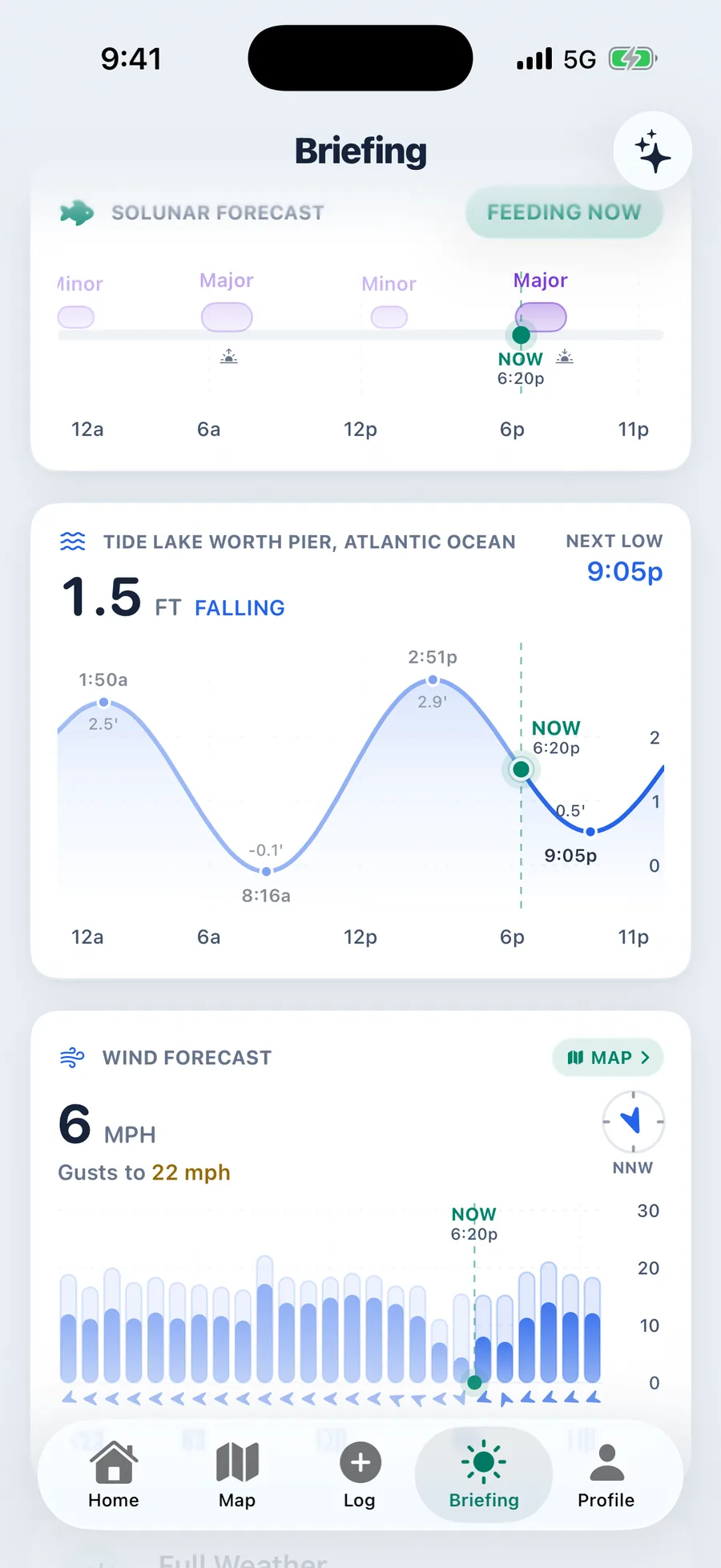
Not a generic sine wave. The actual predicted curve from your nearest NOAA CO OPS station, named on the card, with every turn labeled and timed, and a rising or falling badge so there is no ambiguity.
- Named station so you know exactly which gauge you are reading
- All four turns with times, for example low 3:50a, high 9:52a, low 3:53p, high 10:18p
- Rising or falling stated outright, plus a live now marker on the curve
- Height axis in feet so you can judge the range, not just the direction
Where solunar meets the tide
The windows card stacks majors and minors over the tide turns and daylight edges, then names the single best hour.
Majors and minors
Major periods when the moon is overhead or underfoot, minors at moonrise and moonset. Plotted as bands across the day rather than buried in a table.
Light edges
Sunrise and sunset marked on the same axis, because a minor that lands on last light is worth more than a major at noon.
The best window
One line under the timeline naming the hour and why, for example 7:57 to 8:57p, minor plus last light. That is the whole point of the card.
Tide stage
Incoming, outgoing, slack high, slack low. Shown as a chip in the conditions strip and factored into the bite score directly.
Moon phase
Current phase with illumination, alongside cloud cover. A full moon under heavy overcast fishes very differently from a clear one.
Seven day view
Step forward through the week and watch the windows drift, so you can pick the day rather than settle for the one you have off.
About tides and solunar
The nearest NOAA CO OPS station to the area you have selected, and the station name is printed on the tide card so you can verify it. Change your area and the station changes with it.
It is a correlation, not a law. Major and minor periods track moon transit times, and plenty of anglers find those windows productive, especially where they overlap a tide turn or first and last light. Cobia treats it as one weighted input among many rather than the whole answer. Our guide on solunar theory goes into what holds up and what does not.
Tomorrow morning starts tonight
Set your home water, pick a drive radius, and wake up to a plan.
Android coming soon
iPhone, iOS 17 or later. Setup takes about a minute.